
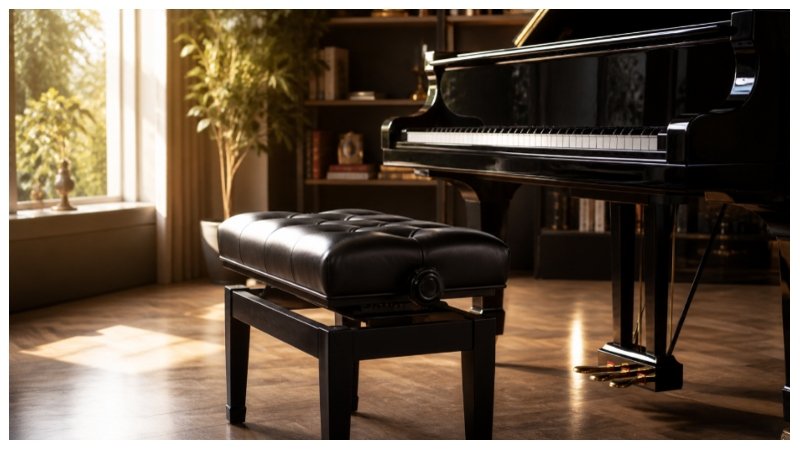
You sit down to play with full intention, yet within minutes, your posture begins to shift. Your shoulders creep upwards, your wrists begin to angle awkwardly, and your lower back begins to fatigue. Due to this, your focus is not on the music anymore but on your body. Although your technique is good, discomfort comes in the way of control and consistency.
Gradually, this micro-aggression can restrict advancement, decrease the amount of practice, and diminish the expression range. In most situations, it is not the piano or your ability, but the bench. The sitting position that you employ will directly influence the manner in which the body reacts with the instrument.
This article describes the effects of the piano bench on comfort, posture, and performance and how making the right decision can make a big difference in your playing experience.
1. Proper Bench Height Sets the Foundation for Technique
As soon as you sit at the piano, your alignment will decide how well you can play. It is why piano benches are not just simple seating, but determine the physical connection between you and the instrument.
At the correct height, your forearms will be parallel to the floor, and your wrists will be relaxed. This means that your fingers are able to move freely over the keys without needless tension. But when the bench is too low, your wrists will be below the keyboard level, so your fingers have to compensate. On the contrary, when it is too high, your shoulders are raised, and it becomes inflexible and restricts fluid movement.
This is directly dealt with by adjustable benches. They enable you to adjust your stance depending on your height, length of arm, and playing style. This is particularly significant when two or more players share a common piano or when switching to other instruments.
Ultimately, correct bench height ensures:
- Better finger control
- The decreased stress on wrists and shoulders
- Enhanced uniformity in touch and dynamics
In the absence of this, even the sophisticated techniques will be shaky.
2. Ergonomic Support Enhances Long Practice Sessions
The more you practice, the more physical comfort becomes more than a luxury, it becomes a necessity. And even the slightest discomfort, without proper support, will gradually affect concentration.
A bench that is designed in an ergonomic manner encourages a natural body alignment. Rather than pushing your body to be in line, it helps to support your spine, which makes it easy to sit upright with minimum effort. As a result, your core will be engaged naturally, and your upper body will be relaxed.
The quality of padding is very important here. High-density cushioning spreads the weight evenly, which decreases the pressure on the hip and thigh. At the same time, it maintains its structure over time, preventing the “sinking” effect that leads to uneven posture.
Moreover, ergonomic chairs minimize the necessity to make regular adjustments. Instead of moving around and changing your posture several times, you stand still and concentrate on the music. The kind of stability directly affects your performance in reading complex passages and maintaining rhythmic stability.
During longer sessions, effective support assists:
- Minimize lower back strain
- Avoid hip and leg fatigue
- Sustain mental focus
Consequently, you will be able to train longer and more efficiently, without affecting your physical health.
3. Stability Directly Affects Control and Precision
Although comfort is crucial, stability is also crucial to performance. The timing, balance, and control can be disrupted by any unwanted motion in your seating.
A solid, well-built bench removes the wobbling and shifting. This stability enables your body to stay stationary as your hands move freely. As a result, you have more control over the dynamics, articulation, and phrasing.
The quality of the materials is prominent here. The use of hardwood in the framing, reinforced joints, and precision-built mechanisms all help in creating a firm, reliable structure. Also, good quality adjustment systems make sure that when you have set the height, it remains the same throughout your session.
Stable seating improves:
- Accuracy in fast passages
- Balance during dynamic changes
- Confidence in performance settings
Contrastingly, a wiggly bench presents minor inconsistencies that may affect even the most rehearsed music.
4. Adjustability Supports Different Playing Styles and Needs
Every pianist has a unique physical build and playing approach. Because of this, a fixed-height bench rarely meets all needs.
Adjustable benches offer flexibility, allowing you to tailor your seating position to your specific requirements. For instance, some players prefer a slightly higher position to improve visibility and control, while others favor a lower stance for expressive phrasing.
This adaptability becomes even more important in shared environments. In teaching studios or family settings, multiple players of different heights use the same instrument. With an adjustable bench, each person can quickly find their ideal position without compromising comfort or technique.
Advanced adjustment systems provide:
- Fine, incremental height control
- Smooth and quiet operation
- Consistent support at every level
Moreover, adjustability allows you to adapt to different musical contexts. For example, technical exercises may benefit from one position, while expressive repertoire may require another.
Final Thoughts
Your connection to the piano begins the moment you sit down. While technique, practice, and musicality are essential, they rely on a stable and supportive physical foundation.
The right bench aligns your posture, supports your body, and allows your hands to move with precision. In contrast, poor seating introduces unnecessary challenges that can limit both comfort and performance.
By focusing on height, ergonomics, stability, adjustability, and materials, you create an environment where your playing can develop without physical barriers. And when your body is properly supported, your attention can shift fully to expression, control, and musical depth.
In practical terms, improving your seating setup is one of the most immediate and effective ways to enhance your overall piano experience.