
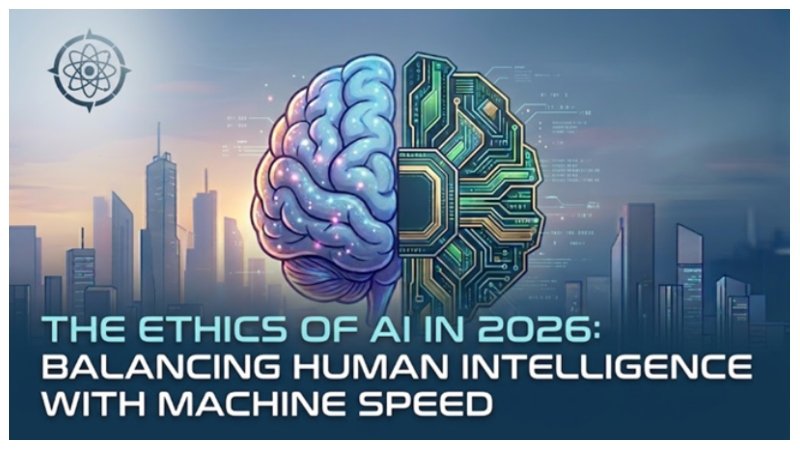
The digital landscape of 2026 has reached a definitive crossroads. We are no longer debating whether artificial intelligence will integrate into our daily lives; instead, we are grappling with how to preserve the sanctity of human intuition in an era defined by near-instantaneous machine processing. As algorithms evolve from simple predictive tools to sophisticated generative agents, the ethical boundary between “assistance” and “replacement” has blurred. Maintaining a balance requires a conscious effort to prioritize cognitive empathy and moral reasoning—traits that remain uniquely biological—even as we embrace the undeniable efficiency of silicon-based logic.
The pursuit of this balance is particularly visible within high-pressure environments where the volume of data often exceeds a single person’s capacity for synthesis. For instance, modern researchers and students often face overwhelming academic loads that require a blend of rapid data sorting and deep, critical analysis. In these scenarios, seeking university assignment help from established platforms like myassignmenthelp has transitioned from a simple convenience to a strategic necessity for maintaining mental well-being. By entrusting the initial data gathering to specialized consultants, individuals can concentrate their “human intelligence” on the ethical implications and creative nuances of their work, ensuring that the final output possesses a unique essence that no machine can replicate.
The Cognitive Load Crisis and the Necessity of Delegation
As machine speed accelerates, the human brain is constantly bombarded by what psychologists refer to as “the cognitive load funnel.” We are bombarded with more information in a single afternoon than our ancestors processed in a lifetime. This saturation leads to “decision fatigue,” where our ability to make ethical choices or perform deep work diminishes as the day progresses. The ethics of AI in 2026 suggest that the most moral use of technology is to alleviate this burden. When we use AI to handle repetitive, high-speed tasks, we “clear the deck” for higher-order thinking.
However, the trap lies in total reliance. If we allow machine speed to dictate the pace of our thoughts, we lose the ability to sit with a problem, to “brood” over a concept, and to reach a conclusion that feels earned rather than calculated. The ethical practitioner in 2026 is not the one who works the fastest, but the one who knows exactly when to slow down and let human intuition take the lead.
The Ethical Framework: Human vs. Machine Strengths
To understand how to balance these two forces, we must categorize what each entity does best. The following table illustrates the 2026 standard for Task Allocation:
| Feature | Machine Speed (AI) | Human Intelligence (HI) | Ethical Synergy |
| Processing | Mass data ingestion in milliseconds. | Deep contextual understanding. | AI gathers; humans interpret. |
| Logic | Boolean, mathematical, and linear. | Emotional, moral, and nuanced. | AI optimizes; humans validate. |
| Creativity | Recombination of existing data. | Original “Information Gain” and “Spark.” | AI drafts; humans innovate. |
| Bias | Mirror of training data (inherent). | Capable of self-correction and empathy. | Human audits AI for fairness. |
| Endurance | Infinite; 24/7 operation. | Limited; requires rest and reflection. | AI handles the “noise”; humans the “signal.” |
Algorithmic Accountability and the Transparency Mandate
One of the greatest ethical hurdles we face is the “black box” problem. As AI systems become more complex, the path they take to reach a conclusion becomes harder to trace. In 2026, the concept of Explainable AI (XAI) has become a global standard. It is no longer enough for a machine to provide a correct answer; it must be able to show its “workings” in a way that a human can audit for bias, error, or logical fallacies. This transparency is the only way to build a symbiotic relationship between human and machine.
Without this accountability, we risk a “delegation of conscience,” where humans blame the algorithm for biased outcomes or systemic errors. Whether in healthcare, law, or complex technical fields, the final check must always be human-led. For those navigating the rigorous demands of technical degrees, finding reliable engineering assignment help is often a way to see these complex systems explained clearly, ensuring that the student understands the underlying logic before applying machine-generated data to real-world infrastructure.
The Global Shift Toward “Information Gain”
In the SEO and content landscape of 2026, Google has moved away from rewarding “perfect” text. Instead, it prioritizes information gain—the inclusion of new facts, unique perspectives, or original data that an AI model cannot simply predict based on its training. If an article looks like a machine wrote it, it is relegated to the back pages.
This creates a fascinating ethical paradox: To rank well on a machine (Google), you must prove you are intensely human. This means sharing lived experiences, using “Human-First” language, and avoiding the sterile cliches that AI models lean on. Authentic content in 2026 is characterized by:
- Somatic Language: Describing things in ways that require a physical body to understand.
- Moral Friction: Discussing the “gray areas” where there is no mathematically correct answer.
- Real-Time Relevance: Linking concepts to current global events with a tone of “Global Citizenship.”
The Future of “Human-Verified” Content
In a world saturated with synthetic media, the value of the “human signature” has skyrocketed. We are seeing a move away from generic content toward high-fidelity, expert-verified resources. This is particularly true in professional and academic spheres where the stakes are high. The ethics of AI suggest that while a machine can draft a document in seconds, verification—the checking of facts, the nuances of tone, and the alignment with cultural values—is a task that must remain in human hands to ensure social and intellectual integrity.
Navigating the Symbiotic Future
Looking forward, the goal is not a competition between biological and artificial intelligence but a transition toward augmented intelligence. This is a state where the speed of the machine serves the wisdom of the human. To navigate this future ethically, we must adopt a “human-first” framework for every digital interaction.
- Prioritize Intuition: Never let a machine-generated suggestion override a gut feeling without a thorough audit.
- Strategic Delegation: Use technology to handle the “noise” so you can focus on the “signal.” By using professional services for research and drafting, individuals preserve their limited “cognitive budget” for higher-level innovation.
- Maintain Transparency: Always be clear about where the machine ends and the human begins. This is not just a legal requirement but a moral one.
Summary: The 2026 Ethical Standard
The true “machine speed” isn’t about how fast a processor runs; it’s about how quickly we can turn data into wisdom. In 2026, the most successful individuals and organizations are those that treat AI as a high-speed assistant while retaining the “moral compass” of human intelligence.
As we continue to build this world, let us remember that while an algorithm can calculate the distance between two points with absolute precision, only a human can explain why the journey matters. By balancing the “how” of the machine with the “why” of the human, we create a future that is not only faster but significantly better for everyone involved.
By following these principles, we can ensure that the rapid advancements of 2026 do not lead to a dilution of our collective intellect but rather a sharpening of our most essential human qualities. We have the tools to build a world that is both incredibly fast and deeply thoughtful; the challenge is ensuring we don’t lose our pace—or our principles—in the process.
Frequently Asked Questions
How does human intuition balance machine speed?
While machines process data at near-instantaneous rates, human intuition provides the essential moral context and deep understanding required to interpret that data. This synergy ensures that rapid outputs are governed by ethical reasoning and lived experience.
What is the “Cognitive Load Funnel” in modern workflows?
This concept describes the overwhelming saturation of information that leads to decision fatigue. By delegating repetitive or high-volume data tasks to digital tools, individuals can clear mental space for high-level creative and strategic thinking.
Why is transparency critical for algorithmic accountability?
As systems become more complex, “Explainable AI” ensures that the logic behind a conclusion is visible. This allows for human audits to identify potential biases or errors, ensuring the final results remain fair and reliable.
How is the value of content determined in 2026?
The focus has shifted toward “Information Gain,” where the most valuable content is that which offers unique insights or expert verification. Human-led verification is now the gold standard for maintaining intellectual integrity in a digital-first world.
About The Author
Min Seow is a dedicated content strategist and digital marketing professional at MyAssignmentHelp. With a focus on bridging the gap between emerging technology and academic integrity, Min specializes in creating insightful, human-centered narratives that help a global audience navigate the complexities of modern education and professional development.